Beyond the Slop Machine
The promise of AI is range not replacement.
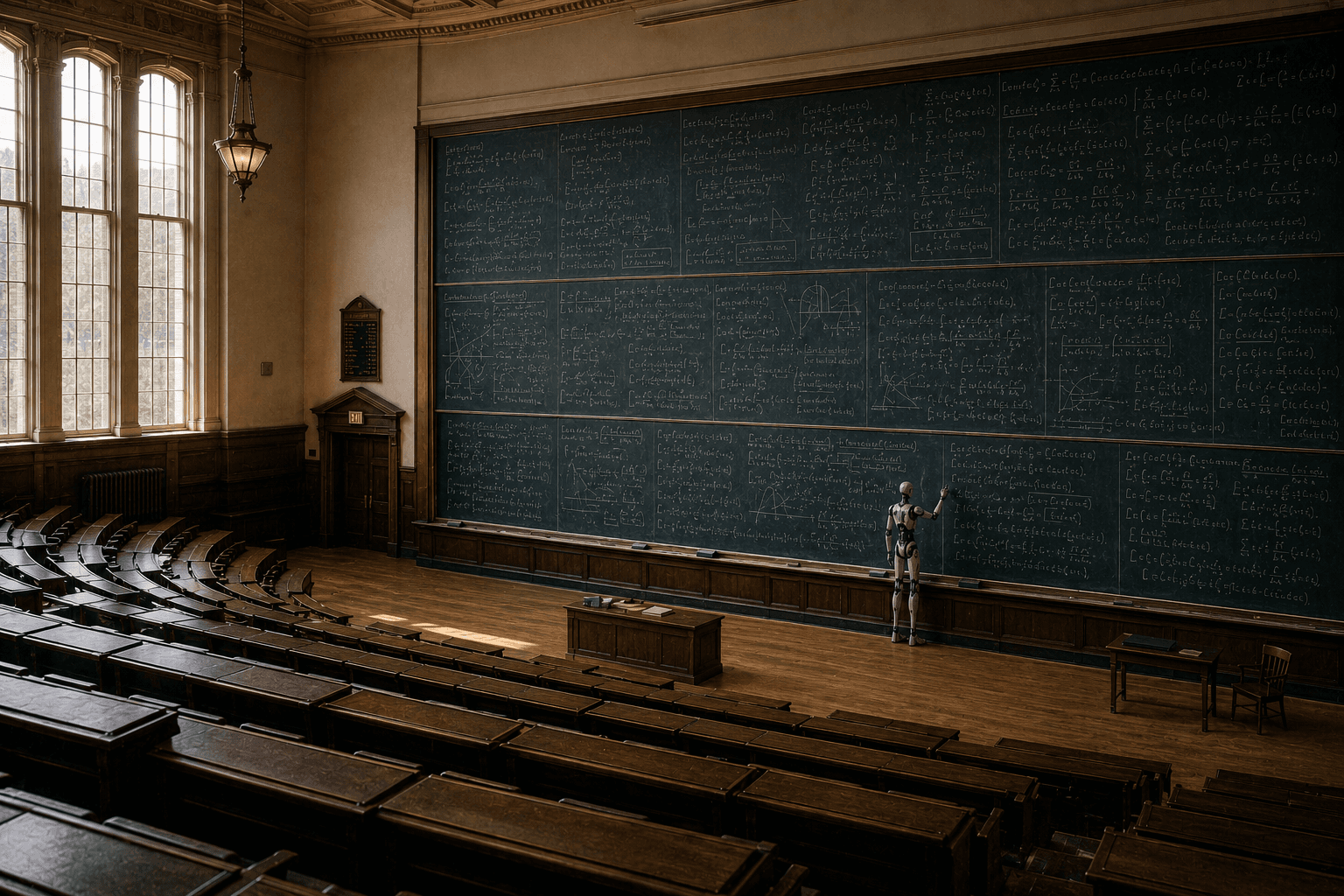
There’s a version of the AI-in-media debate that has split into two camps. On one side, AI is coming for creative jobs and will flood the zone with synthetic slop. On the other, AI is a miracle tool that will revolutionize everything it touches. Neither version is particularly useful.
The more interesting question, and the one I think the industry should actually be wrestling with, is what happens when you leverage AI as a creative partner. Not a replacement. Not a threat. A tool and collaborator that magnifies and extends the capabilities a human has, inside a process where human taste, judgment, and vision are still doing the steering.
Software engineering is already living this. The best developers aren’t writing less code because they’ve stopped thinking. They’re using AI as a creative partner inside a structured process, and the work is getting more ambitious, not less. The craft has evolved. It hasn’t been displaced.
Can the same be true for content creation?
At the more skeptical end of the spectrum, Justine Bateman has argued that “Generative AI is a regurgitation of the past by the sheer definition of how it functions. It’s the ultimate reboot-rehashing-sequel machine.” That critique captures a real fear in Hollywood: that AI will not liberate creators, but industrialize derivation.
This week’s AlphaProof Nexus results complicate one part of the argument: the claim that AI is inherently incapable of producing anything genuinely new. The complication comes from an unexpected direction… math proofs.
AlphaProof Nexus, a system combining large language models with the Lean formal proof environment, resolved 9 of 353 open Erdős problems it attempted, including two questions that had been open for 56 years. The paper also reports that it proved 44 of 492 open OEIS conjectures, with the Erdős results coming at an inference cost of a few hundred dollars per problem.
That does not mean the LLM “felt” insight. It does not mean mathematical discovery and artistic creation are the same thing. They aren’t. Verification in math is a straight line. The value of creative output is driven by taste and harder to validate.
But that distinction cuts both ways.
DeepMind was not merely asked to imitate a known answer. It had to search through a space of possible constructions, identify a new path forward and return something that survived verification. In math, at least, “just predicting the next token” has become an inadequate description of what these systems can do when paired with tools, feedback loops, and hard external tests.
The obvious objection is that this is still an optimization loop. Fair enough. Worth noting, though, revision is not foreign to creativity. Writers rewrite. Editors cut. Directors reshoot. Musicians noodle, discard, repeat, and eventually find the thing. The presence of iteration does not make an output uncreative. Often, iteration is how creative work becomes worth keeping.
The better critique is narrower: mathematical output is easier to assess than artistic output. That is true. A Lean proof is either valid or it is not. A screenplay can be technically polished and still dead on arrival. A shot can be novel and emotionally empty. A song can be original and unlistenable.
So no, AlphaProof Nexus does not prove that AI can make great films.
But it does suggest that AI’s creative ceiling is higher than “regurgitation.” And that matters for how the industry thinks about partnership.
Art is rarely pure, uninfluenced creation, and that’s not a bad thing. West Side Story came from Romeo and Juliet. Cruel Intentions came from Les Liaisons Dangereuses. O Brother, Where Art Thou? came from The Odyssey. Apocalypse Now came from Heart of Darkness. Influence, adaptation, theft, homage, inversion, recombination. These are not exceptions to art history.
Every artist is a cannibal, every poet is a thief.
All kill their inspiration and sing about the grief.
— Bono, The Fly
The real question has never been whether the source material existed before. It is whether the artist, the tool, or the collaboration produces something that changes the experience of the audience. Something surprising and alive and that could not have been reached by merely averaging the past.
That is where the AI debate in media should move next.
Not to the fantasy that machines are artists in the human sense. Not to the equally lazy certainty that machines can only produce derivative sludge. The more useful question is what happens when writers, filmmakers, designers, musicians, and editors use these systems inside a disciplined creative process… with taste, constraints, judgment, and responsibility still in human hands.
The distinction matters for Hollywood right now. Matt Belloni recently wrote about franchise fatigue and the widening gap between young audiences and the industry’s more formulaic bets. Established IP still pulls people toward theaters, but the larger signal is hard to miss: audiences are drowning in familiarity and increasingly skeptical that the next extension of the same universe will give them anything they have not already seen.
That is where AI could go wrong. But, used as a creative partner... That’s where AI could also become part of the escape route.
Not because AI replaces the filmmaker. Because it may widen the search space. It may help creators test stranger combinations, visualize impossible options, break stale story patterns, and get past the reflexive safety of the familiar. The difference will not be the technology by itself. It will be the taste and courage of the people using it.
That’s a horizon worth sailing toward. One where AI is not a replacement engine, but a partner... not an author, nor a soul. A tool that can sometimes help human creators reach places they might not have reached alone.
Image credit: Screenshot from OpenAI’s “The Erdős Breakthrough” video, part of a broader wave of recent AI/math advances challenging the idea that these systems can only remix the past.