Can Agents Operate Your Media Stack?
Measuring the media technology industry's readiness for agentic workflows
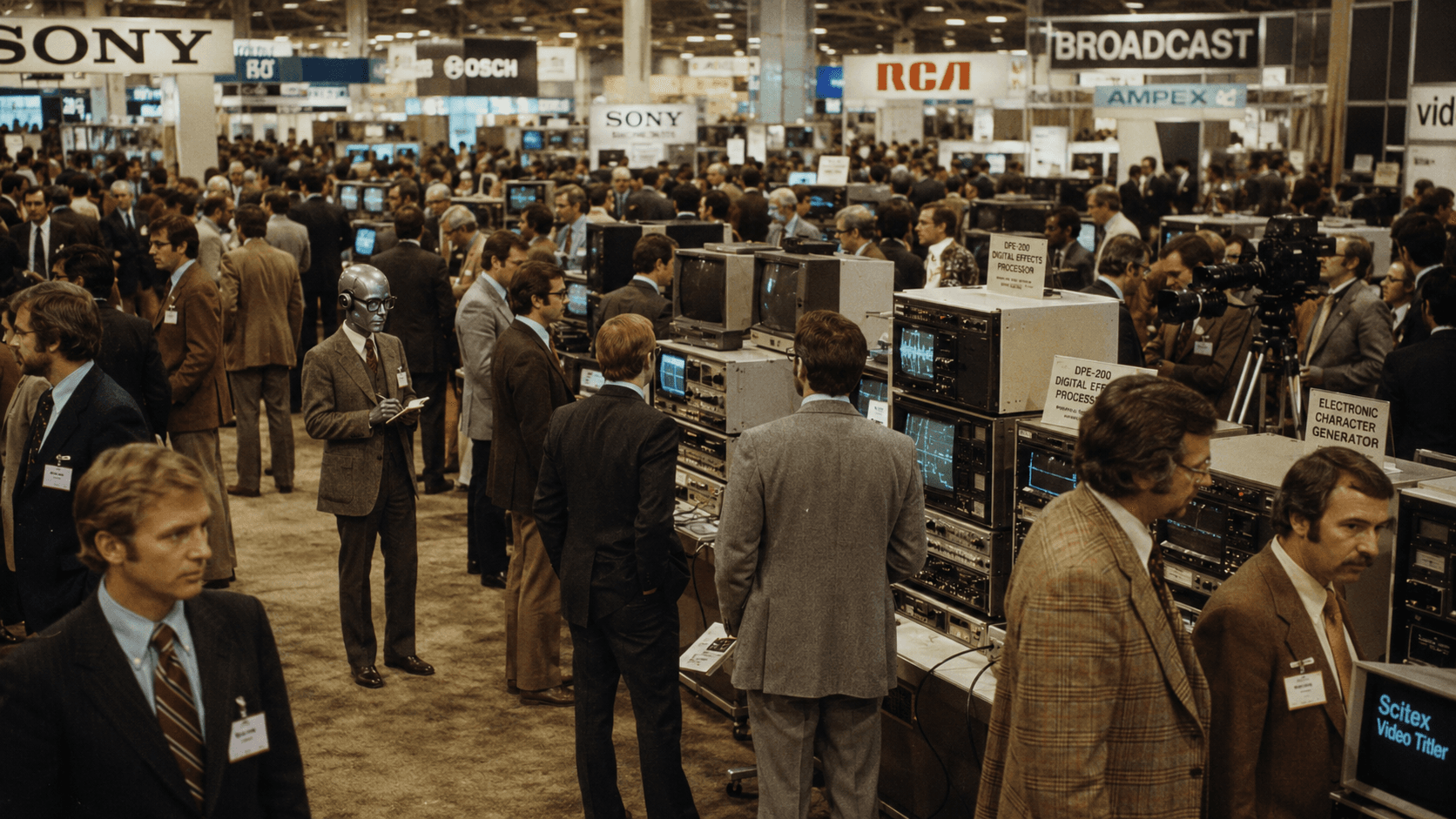
With IBC about to begin, I’ve been thinking about NAB 2026 earlier this year where the floor had the energy of an industry in transition. AI marketing was everywhere. Nearly every booth had a story about how AI was improving the product. Smarter search. Automated tagging. Better title matching. Intelligent recommendations. New and improved!
Here’s the thing. Everyone spoke about how their products used AI. Few spoke about how AI used their products.
The distinction matters because a product that uses AI internally is very different from one that can be used by AI externally. The first is like putting a better engine in the same vehicle. The second changes the kind of vehicle you are building. One improves the experience for a human operator. The other makes it possible for an agent to invoke the product directly as part of a larger workflow.
At NAB, I asked booth staffers the same question: “If I asked an agent to perform a task that required your product, could the agent invoke it reliably? Not a human navigating your UI with an AI assistant, but an agent acting on an expressed intent, invoking your capabilities directly, completing the work and reporting back.”
The honest, near-universal answer was “No”.
The products themselves are not the problem. Many are functionally very strong. They were simply built for human operators navigating graphical interfaces, for human UX rather than agent experience, or AX.
What Agentic Engineering Already Looks Like
That stood out because our own engineering experience looks very different.
At Mediafier, we use Claude Code and Codex to build. More to come on what we’re building, but the relevant point is that our agents use many products while we work. GitHub as our code repository. Supabase for database and backend infrastructure. Vercel for hosting and deployment. Sentry for error tracking. Linear for ticketing and our development ledger.
We use all of them constantly through agents without opening their websites. Sure, we still visit those sites now and again, but well over 95% of the day-to-day interaction happens through Claude Code and Codex agents acting on our behalf.
That experience changes your expectations quickly. When you know what you need, you want to start using a tool immediately. Once the agent is authorized with an API key or OAuth handshake, it should be able to understand the product, invoke it and get on with the work. Anything that forces you through marketing pages, lengthy onboarding, or a sales call before you can evaluate the actual capability is now an impediment.
This is already normal in agentic engineering. There is no reason to think media operations will be fundamentally different.
Confirmation at DPP
A month after NAB, the same theme came up repeatedly at the DPP Media Supply Festival. CTOs and engineering leaders asked for headless access to tools, directly invokable services, and automation that could be run through CLI or MCP without requiring someone to move manually between platforms.
The shift in media technology is not simply about adding AI to products. It is about making products callable, composable and usable by agents as part of larger workflows. As agents increasingly select and orchestrate the tools used in content operations, the products that are easiest for agents to discover, understand and use will have an advantage.
Building the Agent Experience Index (AXI)
That raised a pretty obvious question: If AX is important, can one measure it?
We decided to try. We assembled a cohort of more than 100 media technology products across asset management, media transformation, business systems, playout, distribution, monetization, creative technologies and other segments. We also included a benchmark group with companies such as Supabase, Stripe, Vercel, AWS and GCP. While they do not compete with media technology vendors, they represent what good, agent-native infrastructure looks like today. They set the bar.
We built a rubric around the things that matter for agentic operation: documentation quality (for language model consumption), MCP and CLI availability, interface maturity, authentication, governance, and commercial readiness for autonomous execution. We then had Gemini, ChatGPT and Claude evaluate the cohort. I call the result the Agent Experience Index, or AXI.
AXI is not Mediafier’s core product. It is instrumentation that informs our platform. We wanted a way to understand how ready the media technology ecosystem is for the kind of agentic workflows that we believe are coming, and to identify where the friction still sits.
First Results
The results were sobering and showed just how much work remains. On a scale of 0 to 100, the benchmark companies scored between 80 and 100, which we classify as Agent Native. The majority of media technology products scored between 0 and 35. Not even whelming. In fact, totally underwhelming.
Most media tech products remain firmly Human Operated. Few expose meaningful MCP or CLI interfaces. Documentation is largely written for human developers rather than for models trying to understand what a service does and how to invoke it. Only a handful came close to agent-native design.
ElevenLabs stood out. It held its own against the benchmark companies and looks much more like a product designed from the beginning for programmatic and agentic consumption.
Some of you are likely ready with the critique… “Well Brian, many of those capabilities and proof points lie behind access restrictions that none of the evaluating LLMs can see." I hear you and acknowledge that many of those capabilities sit behind gates that the evaluating models can't see through. Fair point. But if your product's agentic surface is invisible to the models, it's invisible, or at best unnecessarily difficult, for the agents your customers will be sending to use it. That's the issue.
Implications
AXI instruments the ecosystem’s readiness to participate in agentic media workflows. Low scores do not mean the products are bad. They mean the products were designed for a different operating model. The interesting part is what happens as the industry move to a new model.
Agentic engineering already gives us a preview. The orchestration layer increasingly sits above individual products, and agents choose and invoke the capabilities required to complete the work. In media, that will require more than just callable tools. Agents will also need context about the content, permissions, policy, workflow state and prior decisions before they can operate reliably across the stack.
That is part of what we are building at Mediafier. We are not ready to formally launch it yet, but the short version is that there is a need for a context management layer that sits across the existing media technology stack and makes those systems available to agents through a governed operating layer. AXI helps us understand how ready the underlying ecosystem is to participate in that model.
There will be much more to say about both.
For now, I’m looking forward to IBC. I’m hoping to hear fewer stories about how products use AI and more about how AI can use those products. With AXI, we at least have a way to measure the difference.
To those attending, have a great show and reach out if you'd like to connect there.