Media as Code
Rethinking Media as a Structured, Composable System
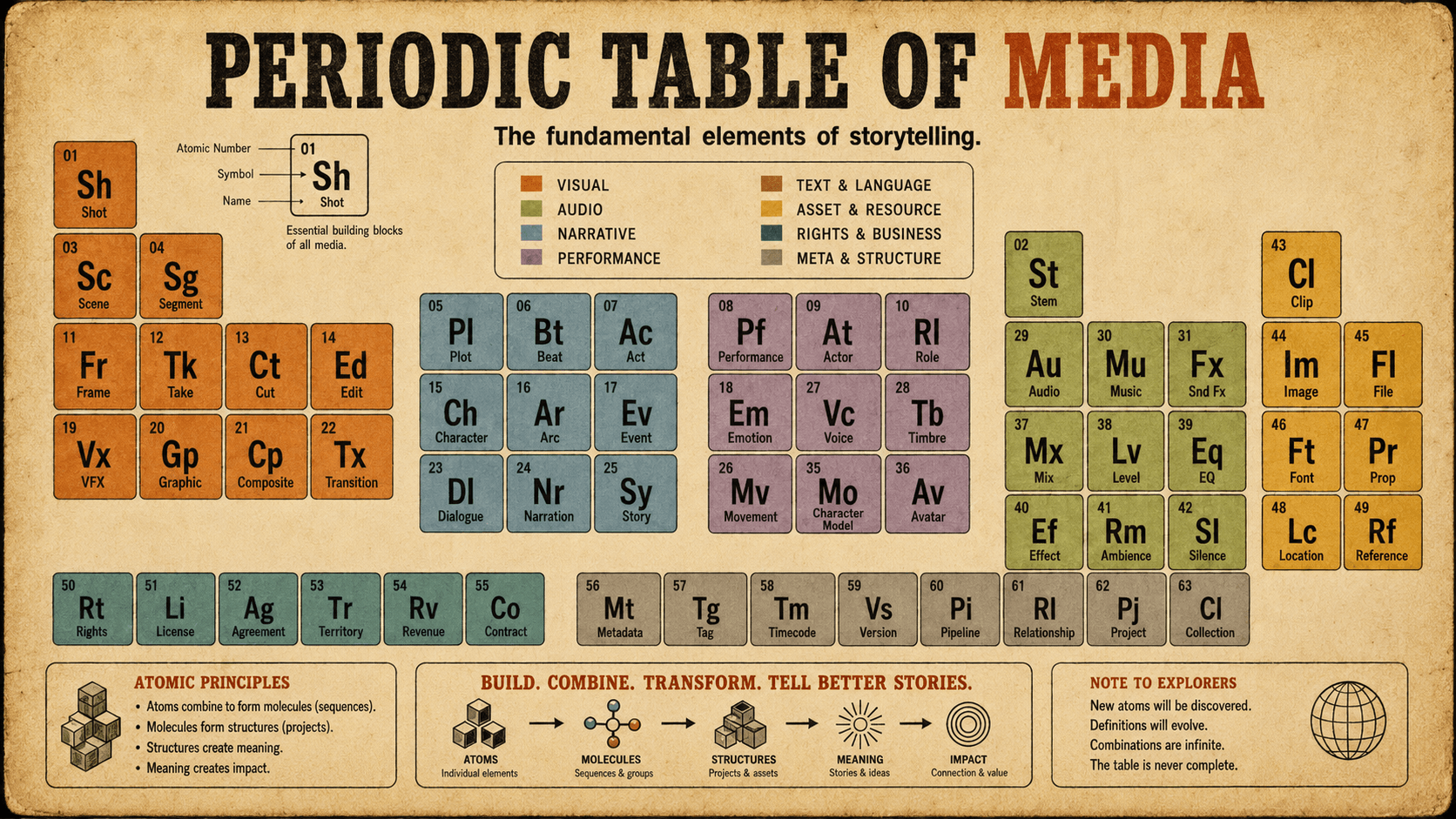
One of the core ideas I keep coming back to in thinking about the AI future of media is “Media as Code.” Not media as a metaphor for software. Media as a structured, addressable, composable system.
Today, most media is still treated as an opaque file. A film is a video file. A podcast is an audio file. A song is a track. A short-form video is an export. The file is the unit of work.
But that is not how media is actually made, understood, or transformed.
Media is composed of atoms: frames, shots, scenes, segments, dialogue, characters, performers, voices, actors, music stems, sound effects, captions, transcripts, regions, objects, graphics, rights, versions, and metadata. Some of those atoms are creative, some technical, some semantic, and some commercial. The problem is that most are not exposed as a system in a consistent, addressable, machine-readable way.
That gap has started to feel increasingly important in an era of AI.
I’ve been spending time recently using Claude Design for website work and presentations. What strikes me about Claude Design is not just the output quality, though that is impressive. It’s the structured design system on which it is founded.
Claude starts by turning an input into a design system: typography, color, spacing, layout, graphic components, hierarchy. Websites and decks already provide structured parts it can manipulate, but Claude Design also atomizes graphics into parts. The creative is not a single opaque artifact. It is an assembly of discrete elements that can be modified, recombined, versioned, and reconstructed.
The creative output is the assembly. Those atoms are the leverage.
With that lens, when Reve published its “Layout Bet” post a week ago, it struck me as notable.
Reve is an image generation company, but its thesis is architectural, not just aesthetic. Instead of generating an image directly from a text prompt and hoping for the best, Reve introduces a structured intermediate layer: a layout. A hierarchical map of the image where regions, objects, positions, sizes, descriptions, and references are defined before the pixels are rendered.
The model plans the structure first. Then it generates the image.
That’s a meaningful shift.
The layout becomes a shared interface between human and machine. You can refine the image with natural language, or directly edit the structure itself: move a region, change an object, add a reference, adjust the relationship between parts.
That goes beyond prompting, and starts to look like programming. Images as code.
I don’t mean programming in the narrow sense of writing software. Programming in the broader sense of defining a creative system. In this case, defining an explicit, inspectable structure that can be edited, versioned, and executed to meet creative needs.
When a domain decomposes its artifacts into structured, machine-readable atoms, the atoms become individually addressable and the recombination space expands dramatically.
That is the deeper promise of Media as Code.
A film becomes more than a single finished asset. It becomes a structured assembly of frames, scenes, characters, performances, dialogue, music, rights, and transformations. A podcast becomes speakers, topics, segments, claims, quotes, clips, transcripts, voice models, music beds, and distribution rules. A music track becomes stems, tempo, structure, instruments, vocal timbre, rights, versions, edits, and remixable components.
Once media is represented this way, AI gets much more powerful.
Localization stops being a post-production afterthought and becomes a transformation applied to structure. Versioning stops being “which file is the right file” and becomes actual version control. Personalization stops being a recommendation algorithm choosing between finished products and becomes an adaptation layer operating on the components themselves.
The same applies to compliance, accessibility, highlights, trailers, dubbing, syndication, social edits, archive search, and agentic discovery. These should not be separate workflows operating against opaque files. They should be different operations against the same structured media graph.
Reve is demonstrating this for images. Claude benefits from it in websites and presentations because those formats already have structure. Software engineering has been living it for years.
Media has not had its structured representation moment yet… but it will.
The future of media AI is not better prompting against opaque files. It is structured representation of media assets so agents can inspect, modify, version, transform, and recombine them. The creative process does not get diminished by the atomization. It gets amplified...
The atoms are the leverage, and the assembly is the art.