The Great Replatforming: How AI Interfaces Will Supplant the App Economy
AI is the New UI
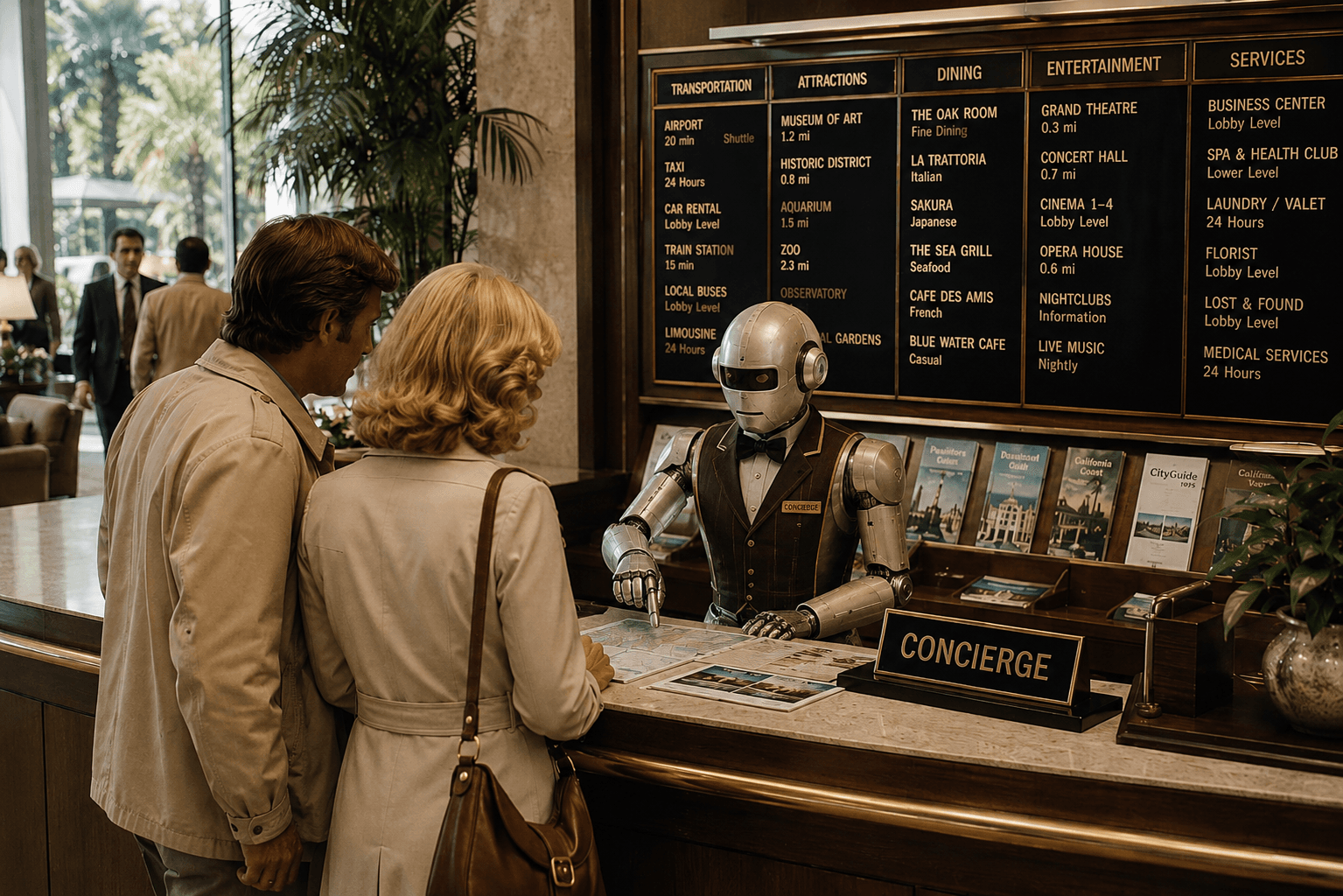
Several weeks back, I wrote about The Evolution of Consumer Interfaces: AI is the New UI. In that article, I forwarded a view that consumer interaction with services and content will increasingly flow through AI assistants, and that the use of discrete websites and apps will diminish over time.
We’re watching that play out, first with AI assistants consuming ad-supported websites and search. Scott Rosenberg at Axios captured that reality (along with the downsides) in a recent article, AI Leaves Web in the Lurch. Short story, if you’re the publisher of an ad-supported recipe website, you have challenges ahead.
Mobile apps are beginning similar erosion as AI assistants become more robust. Apps designed primarily to identify real-world objects from photos will be among the first casualties. Think apps like Vivino or plant identifiers. The progression will continue beyond these examples.
Increasingly, web pages — apps, articles, and files — will become tool calls with AI chat interfaces.
Browser Company CEO Josh Miller
The Maturing of the AI Assistant
Recently, I’ve been conducting an informal poll with colleagues and acquaintances, asking: "In five years, do you expect to order car service or book restaurant reservations by asking an AI assistant, or will you still use dedicated apps like Uber or OpenTable?"
While not scientifically rigorous, the results are telling: the majority expect to place the order through an AI assistant directly. Think about that.
That marks a significant shift from the current landscape and signals a disruptive period ahead, especially for incumbent app providers. Companies like Uber and OpenTable are likely to face mounting pressure as the ecosystem evolves, pushing them from consumer-facing roles toward backend, middleware functions within assistant-driven environments. The rise of technologies such as OpenAI’s Operator and Anthropic’s Claude Computer Use, which can navigate websites and perform tasks on behalf of users (though somewhat clunky from where I sit) will intensify this shift.
To be fair, companies like Uber and OpenTable have significant advantages that make them resilient to "assistant-ification”, including their service provider networks, their brand trust, and their sophisticated user interfaces that optimize specific experiences. Nevertheless, I expect these companies will face meaningful business pressure as technical evolution towards AI assistants matures, as competitors respond, and as alternative agentic solutions emerge.
Seeding the Agent Economy: Two Paths Forward
To explore how AI assistants and a supporting Agent Economy will evolve, it is useful to frame the current positions of the major players in the AI race. Let’s start with a simple framework (depicted below) for where things stand today. The framework buckets the major players into two types: OS players and App players.

Operating system providers (in dark blue) such as Apple and Google offer platforms that span all major device categories, each featuring integrated AI assistants, Siri and Google Assistant respectively. Other OS providers also maintain meaningful positions with built-in assistants. Microsoft dominates the PC market with Windows, now enhanced by its CoPilot assistant. On the TV front, Roku and Amazon lead with their respective operating systems, both featuring integrated voice assistants.
Applications from 3rd parties (in green) commonly live atop these platforms: Uber, Airbnb, Spotify, Instagram, OpenTable, StubHub, Venmo, Zoom, and Netflix among them. Recently, AI apps (in light blue) emerged as a new application category providing extraordinary new utility through access to large language models. ChatGPT leads this category, with Perplexity, Claude, Grok, and Gemini vying for position as well.
The OS players and AI App players present two distinct evolutionary paths for how AI Assistants and supporting agents develop.
The OS Path
Apple and Google are well-positioned to capitalize on their dominance by unifying their operating systems into cohesive, AI-centric OS families, where the operating system itself becomes the foundation for intelligent capabilities. These platforms will continue to evolve with increasingly sophisticated multimodal input and output, including through new device categories like XR. Their integrated assistants will gain advanced agentic functionality that enables seamless and intuitive user experiences. To extend beyond the limits of internal development, both companies will likely continue enlisting third-party developers to broaden the ecosystem and accelerate innovation.

Some 3rd-party extensions may operate as “headless” agents (in purple) that integrate directly into the assistant without needing a standalone app. For example, a restaurant booking agent could conceivably be an embedded agent within the OS’s assistant, eliminating the need for a dedicated app like OpenTable. A hybrid model is also likely (in green with a purple edge), where a provider like OpenTable might offer some capabilities through the assistant while maintaining a standalone, branded app for more advanced interactions.
Perhaps we’ll see Apple and Google App Stores evolve to support agentic plug-ins into their AI Assistants, in addition to the discrete apps offered today.
The AI App Path
Major application players vying to become dominant AI assistants must take a different approach. These players must move from being point applications to broader super apps that become platforms. These players might also secure new position by developing new device categories (depicted as “Device X” below) that challenge existing mobile phone dominance.
I include ChatGPT, Perplexity, Claude, Grok and Meta AI in this camp. These AI app players are adding sophistication through expansion of integrated AI assistants including the addition of commerce, community and content features. They are also enhancing their interfaces in ways that feel more like platforms than simple apps, supporting ever increasing functionality via new supporting agents.
OpenAI
OpenAI is firing on all these fronts. OpenAI has the leading AI assistant in ChatGPT. They are embedding shopping directly in ChatGPT. They are exploring development of a social network. They hired Fidji Simo from Instacart to lead an applications team. OpenAI partnered with Jony Ive to launch a new consumer device category in 2026. OpenAI clearly has vision and momentum. But, they’re biting off a lot and need to iron out their capital structure.
Anthropic
Anthropic is a key player as well. While Claude lacks ChatGPT's consumer reach, Anthropic leads in AI platform architecture. Last year, Anthropic released Model Context Protocol (MCP) which standardizes the way agentic systems access resources and datasets, and Claude's MCP server integration resembles an early App Store. Anthropic also has a relationship with Amazon as one of their primary equity holders, which should not be discounted.
Meta
Meta is in the mix, though Meta AI is not a meaningful AI app yet. They’re investing heavily to advance LLaMA (their open-weight LLM) and acquire talent. They clearly dominate on social with Instagram and Facebook, which could evolve into a super app. They have an incredible monetization engine through their advertising platforms. Meta’s Glasses platform is among the most exciting new device platforms, promising to pull everything together into a new super AI assistant.
Grok
We can’t rule out Elon. xAI has an advanced LLM and AI assistant platform in Grok, in which Elon is investing billions. X is a powerful social network. Elon recently announced a partnership with Visa to add commerce to X. In Tesla, Elon controls a powerful automotive platform. With Neuralink, he’s entirely rethinking the notion of user interface. He controls StarLink, a connectivity platform with unique ability to hook it all together. And, his end game is not guesswork, he has openly stated his strategy of building X into a super app.
Perplexity
Though smaller, Perplexity shouldn’t be underestimated. They’re a consumer-friendly AI play, and they’re scrappy. They partnered with PayPal to add in chat shopping. They offer a news feed, and capture user preferences around sports teams and stock tickers, which hint at content expansion. Perplexity purchased Read.cv a business-oriented social network, presumably to build social capabilities natively into their platform. They announced a partnership with Deutsche Telecom to launch an AI phone. They’re developing Comet, an AI browser that supports agentic transactions and might power new UI affordances for more advanced interactions. However, with the most modest financial war chest, they likely need to leverage 3rd party developers to “punch beyond their weight” and grow beyond their current position.

The Agent Economy
As the OS and AI App players push forward, they will invest in expanding their native AI assistants to include new services, eventually adding reservations, travel booking, home improvement, car service, education, ticketing, entertainment, productivity tools and more.
Those investments will take the form of partnerships, internal development, and/or a 3rd party developer platform. The ultimate winner will likely embrace all 3 approaches; None of these companies can move quickly enough alone. I expect that an entire ecosystem of 3rd party agents will evolve, offered by incumbents and new players to grow AI assistant functionality.
For the last 15 years, we have lived in the App Economy. That’s not going away, but we may be witnessing the birth of a new age that will rattle App Economy incumbents and norms. We stand on the doorstep of a major replatforming moment and of an Agent Economy that begets entirely new players and business models. That’s exciting.
It also raises a question about how long existing players should continue directing the majority of investment toward winning in the App Economy, versus focusing on emerging model outlined herein. That’s worth serious thought.
There’s a lot of development ahead. In the next post, I’ll highlight some of what needs to be solved for the Agent Economy to flourish, including the multi-model “Kitchen problem” as Ben Thompson identified on Sharp Tech recently. I’ll dig into capabilities that the key OS and AI players will need to support and embrace, including exciting new protocols like MCP.