Transforming Content Libraries for the AI Era
From Chaos to AI Gold: Why Legacy Media Must Unify Their Content Libraries
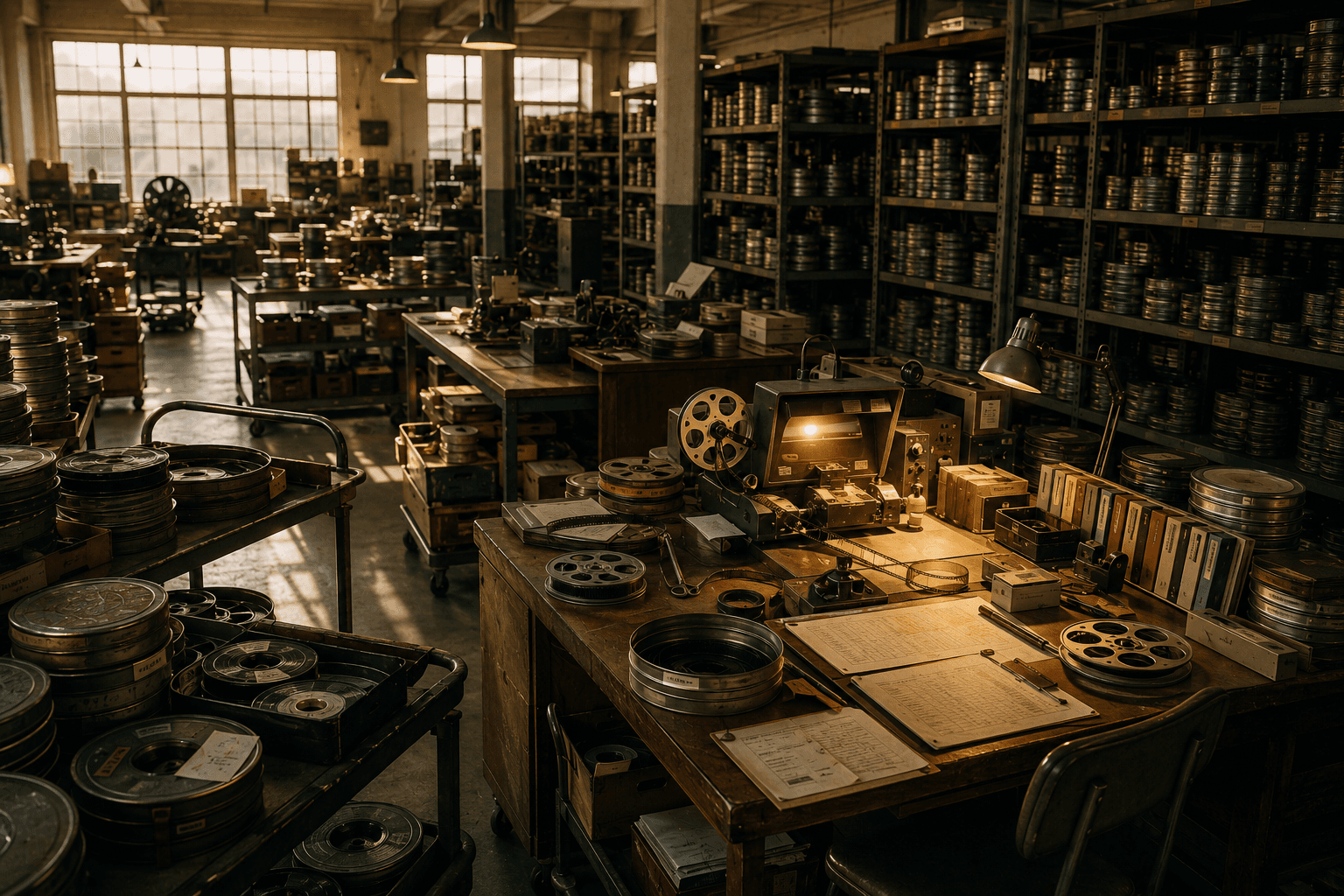
The great news for legacy media companies is that they hold massive libraries of content that have deep, long-standing resonance with consumers and thus massive value. Nevertheless, the history of legacy media's journey to today has consequences that are very different than what Netflix faces, and that history presents legacy media with challenges to address. Today, I'd like to dig into that a bit.
The Consequences of Studio Operations over 50 Years
Legacy media companies tend to store their media in multiple, distributed repositories (MAMs), both internal and external, on-premise and in the cloud, across the globe. These distributed repositories serve long-standing business models, including broadcast, licensing, domestic cable, international cable, and partnerships, each with nuances and complexities. This fractured reality was also fueled by years of library acquisitions and brand mergers. Consequently, these distributed media libraries are, by definition, not in a unified state that 1) optimizes operational costs, 2) can respond rapidly to new models, 3) serves global partners optimally, or 4) presents a clean target against which to apply AI effectively.
Bringing those pools of distributed IP together in a comprehensive, clean, and dense repository is a complicated and thorny problem, more complex than one might initially imagine.
Lessons in the Netflix Approach
Netflix's approach offers a valuable backdrop here. Netflix is an example against which one can understand the consequences of legacy media companies' history of content operations and processing. (Worth noting, Netflix started much later than the incumbents, with a greenfield approach. It never had to wrestle with years of operating in past eras, and thus it paints a good picture of what incumbents must address with their most valuable libraries.)
Netflix started with a vision for efficient, worldwide distribution. It utilizes Interoperable Master Format (IMF) https://en.wikipedia.org/wiki/Interoperable_Master_Format as its normalized media format. IMF is an efficient container format that deconstructs a title into unique, discrete components (video, audio, timed text). Netflix also orders sidecars (e.g., dubs, subs, audio descriptions) as components against the full-length submission asset.
Let's take season 5, episode 4 of Cobra Kai in the US as an example. Netflix offers 18 dubs, audio descriptions in 8 languages, 32 subtitles, and closed captions in 7 languages, with all aligning to a single underlying video asset. It has high sidecar density.
-
Dubs (15) - Czech, English, French, Filipino, German, Hindi, Hungarian, Italian, Japanese, Korean, Polish, Portuguese (Brazilian), Spanish (Lat Am), Spanish (Spain), Turkish
-
Audio Description Dubs (8) - English, French, German, Italian, Polish, Portuguese (Brazilian), Spanish (Lat Am), Spanish (Spain)
-
Subtitles (32) - Arabic, Chinese (Simplified), Chinese (Traditional), Croatian, Czech, Danish, Dutch, Filipino, Finnish, French, German, Greek, Hebrew, Hungarian, Indonesian, Italian, Japanese, Korean, Malay, Norwegian, Polish, Portuguese (Brazil), Portuguese (Portugal), Romanian, Russian, Spanish (Lat Am), Spanish (Spain), Swedish, Thai, Turkish, Ukrainian, Vietnamese
-
Closed Caption Subtitles (7) - English, French, German, Italian, Portuguese (Brazil), Spanish (Lat Am), Spanish (Spain)
As part of its language support, Netflix includes dub cards for all dub languages at the end of the video, though only France and Brazil currently require that. (Dub cards add performance credits for the voice actors of a dub to the asset.) Netflix's uniform strategy across languages simplifies operations and removes complexity down the road.
As depicted below, all the language sidecars for this Netflix title conform to a single video asset.

Beyond the media components, Netflix also has an asset with a universal set of markers and segments to leverage for advertising, personalization, and analytics.
Importantly, this asset can serve as a global master for worldwide distribution.
Of course, that asset might require editing for distribution in territories where regional regulations demand compliance accommodation to address violence, drug use, sex, and language. In these cases, Netflix has the "whole cloth" to create a compliance edit that retains all available sidecars and markers. In other words, Netflix's titles have high sidecar density, providing operational and distribution leverage.
The Fractured Reality of Studio Content Repositories
In legacy media cases, titles are not that tidy. A title's complete set of components frequently reside across global MAMs (asset storage repositories) and vendors platforms, with languages aligned against different video versions…
Some video versions include bars and tones. Some versions pad scene breaks with two seconds of black to accommodate ads. Some versions are texted (with burnt-in, forced narrative text). Some regional copies have a regional dub card added to the end of the video. Slight differences also often exist across video formats. In many cases, languages have been added incrementally for licensing and distribution opportunities against the most readily available video, which is not always the original full-length asset.
The above depicts a representative example of how fractured things can get.
It gets messy. Getting back to a unified state with clean, global masters takes time, resolve, and money.
Preparing for AI and Agentic Operations
To unlock AI's full potential, studios must address their fractured asset base by consolidating and cleaning up their libraries.
This work is no small undertaking, but it's essential for studios seeking to maximize library value as AI creates new monetization opportunities. Libraries must be AI-ready and natively usable by agents.
This transformation turns content libraries into AI gold. Beyond enabling agentic distribution, it unlocks entirely new creative possibilities. Consider colorizing Gunsmoke and rerendering it in HD. Or inserting modern characters into classic content to refresh it for today's audiences. Old news and sports footage could be modernized for contemporary accessibility.
Studios and library holders must begin this work now. Fortunately, library consolidation provides an ideal entry point for migrating to agentic architectures.